Why SOPs Are the Backbone of Healthcare Compliance

If your organization is regulated by the FDA, subject to HIPAA, or covered by OSHA workplace safety standards, Standard Operating Procedures (SOPs) aren't just good business practice — they're a compliance requirement. Auditors, surveyors, and regulatory bodies expect to see documented, repeatable processes that prove your team performs critical tasks consistently, safely, and in line with the law.
Yet many healthcare-adjacent organizations still treat SOPs as a paperwork exercise rather than the operational foundation of a compliant Quality Management System (QMS). That gap is exactly where inspection findings, HIPAA violations, OSHA citations, and costly rework tend to originate.
It's also where a lot of organizations make a second, quieter mistake: treating FDA, HIPAA, and OSHA compliance as three separate projects run by three separate people, each producing SOPs that were never designed to work together. A dental lab might have one binder of quality procedures for FDA purposes, a different HIPAA privacy policy drafted by an outside vendor years ago, and an OSHA safety manual that hasn't been touched since an inspector last visited — none of them cross-referenced, none of them reviewed on the same cycle, and none of them owned by the same person. That's not a compliance program. That's three partial ones, and the gaps between them are exactly what auditors and investigators find first.
What Is an SOP?
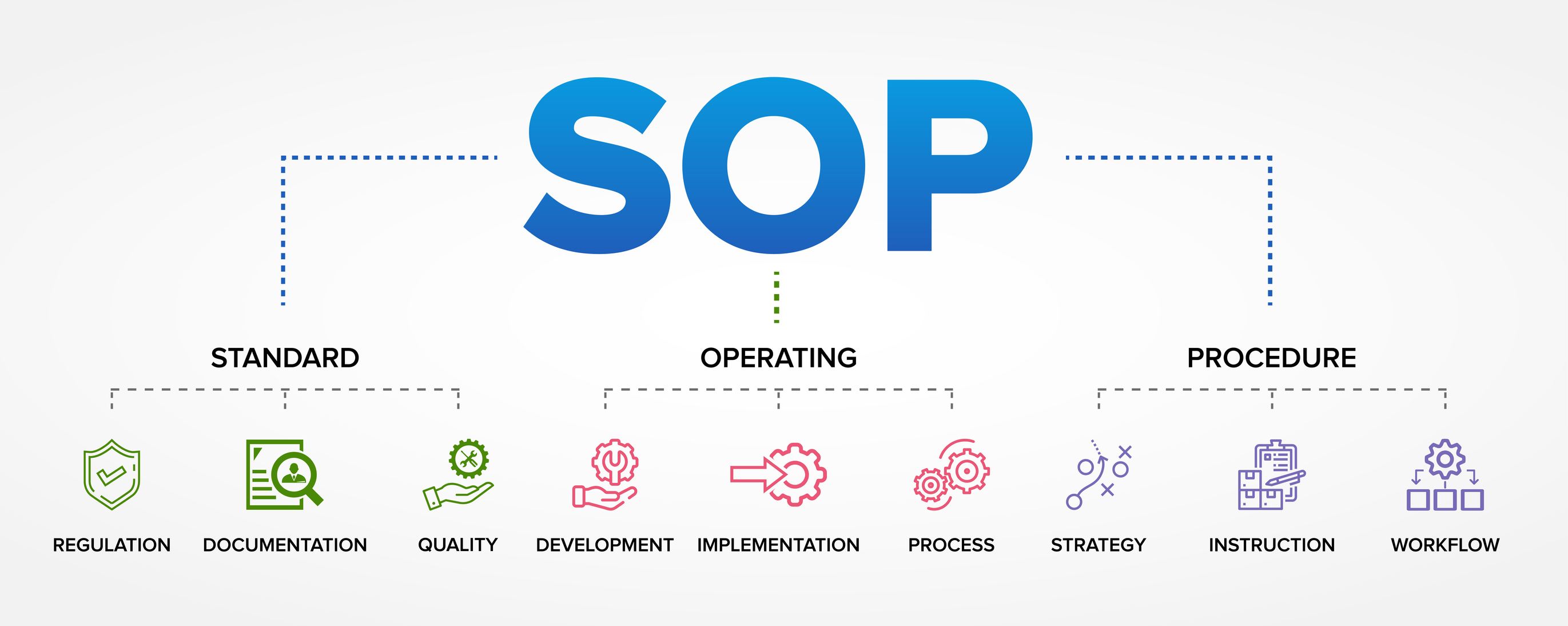
An SOP is a documented, step-by-step description of how a specific task must be performed to consistently meet a quality, safety, or regulatory outcome. In a healthcare or general-industry environment, that might mean:
- How a dental lab technician disinfects and documents an incoming case
- How front-office staff verify identity before releasing protected health information (PHI) under HIPAA
- How a medical device manufacturer performs an incoming material inspection under the FDA's Quality Management System Regulation
- How staff control hazardous energy during equipment maintenance under OSHA's Lockout/Tagout standard, or respond to a bloodborne pathogen exposure incident
- How a practice responds to and documents a reported safety event, complaint, or workplace injury
Regulators don't just want the task done correctly once — they want evidence that it's done the same way, every time, by every trained employee, regardless of which regulation is asking for it. That consistency is what a properly written SOP provides, and it's exactly why SOPs written in isolation from each other tend to fall apart under scrutiny: the same employee who follows a HIPAA-driven privacy procedure at the front desk is often the same person expected to follow an OSHA-driven safety procedure in the back office, and a bloodborne pathogen exposure procedure in the treatment room. If those three documents were written by three different people at three different times, using three different formats, your staff is left reconciling the inconsistencies themselves — usually at the worst possible moment.
SOPs vs. Work Instructions: Know the Difference
This distinction matters more in regulated industries, where inspectors will ask for both:
- SOPs describe the what and why at a process level — for example, "Complaint Handling Procedure" or "Bloodborne Pathogen Exposure Control Procedure."
- Work instructions describe the how in granular, task-level detail — for example, the exact keystrokes used to log a complaint in your quality system, or the specific steps a technician follows to don and doff personal protective equipment.
A compliant QMS typically needs both, with SOPs sitting above work instructions in your documentation hierarchy so auditors can trace a single task back to policy. This hierarchy becomes especially important once you're managing SOPs across multiple regulatory frameworks at once: a single overarching SOP structure — with consistent numbering, review cycles, and approval workflows — lets your FDA-facing quality procedures, your HIPAA-facing privacy procedures, and your OSHA-facing safety procedures all live in one system instead of three disconnected ones.
Bring your compliance program together in one platform. Learn about SafeLink360™.
What Makes an SOP Audit-Ready
A well-written healthcare, FDA, HIPAA, or OSHA-facing SOP should be:
- Unambiguous. No room for interpretation on tasks tied to patient safety, product quality, PHI handling, or employee safety. If two employees could read the same SOP and reasonably do the task two different ways, the SOP isn't finished yet.
- Written in active voice and present tense. "The technician verifies the patient's identity," not "identity should be verified." Passive, hedged language is one of the fastest ways to turn a clear procedure into an ambiguous one, and ambiguity is what inspectors probe for.
- Version-controlled. Every SOP needs a revision history, effective date, and approval signature — auditors will ask, and an SOP without a visible version history reads as unmanaged even if the content itself is solid.
- Aligned to the relevant standard. Whether that's the FDA's Quality Management System Regulation (21 CFR Part 820, harmonized with ISO 13485:2016), HIPAA's Privacy and Security Rules, or an OSHA-mandated written program, your SOP language should map directly back to the specific requirement it satisfies — ideally with the citation noted in the document itself, so anyone reviewing it (staff, auditor, or your own compliance team) can immediately see why the procedure exists.
- Reviewed on a defined cycle. Stale SOPs that don't reflect current practice are one of the most common findings in FDA inspections, HIPAA audits, and OSHA citations alike. A review cycle that's tracked centrally — rather than left to whichever consultant last touched a given document — is what keeps all of your SOPs current at the same time, instead of drifting out of sync with each other.
- Owned by someone specific. Every SOP should have a named owner responsible for keeping it accurate. "Owned by the practice" or "owned by compliance" isn't an owner — it's how SOPs quietly go stale.
Why SOPs Matter More in Regulated Industries
Regulatory compliance. This isn't a marketing claim — each of these frameworks names the requirement directly:
- FDA / medical device manufacturers and dental labs: The FDA's Quality Management System Regulation (21 CFR Part 820) requires you to "establish and maintain a quality management system" (§820.10) and, as of the regulation's 2024 harmonization with ISO 13485:2016 (fully in effect as of the February 2, 2026 compliance date), that system incorporates ISO 13485:2016 by reference — a standard whose clause 4.2 explicitly requires documented procedures as part of your quality management system documentation.
- Healthcare and dental practices (HIPAA): HIPAA doesn't use the word "SOP," but it imposes the same requirement under a different name — "policies and procedures." The Security Rule (45 CFR §164.316) requires covered entities to maintain their policies and procedures in written form, retain them for six years, make them available to the staff responsible for following them, and review and update them periodically. The Privacy Rule (45 CFR §164.530(i)–(j)) imposes a parallel written policies-and-procedures and documentation requirement for how PHI is accessed, used, and disclosed.
- General industry and healthcare facilities (OSHA): Several OSHA standards require a written, documented procedure by name — not just as a best practice. The Hazard Communication Standard (29 CFR §1910.1200(e)) requires a "written hazard communication program." The Bloodborne Pathogens standard (29 CFR §1910.1030(c)(1)) — highly relevant to dental and medical practices — requires a "written Exposure Control Plan," reviewed and updated at least annually. The Control of Hazardous Energy standard (29 CFR §1910.147(c)(4)) requires that energy control procedures be "developed, documented and utilized" for lockout/tagout activities.
Notice what these three frameworks have in common: none of them merely suggest documentation — they require it, in writing, on a defined review schedule, available to the people who have to follow it. A dental or medical practice that's subject to all three isn't dealing with three unrelated obligations. It's dealing with one underlying requirement — documented, current, trained-on procedures — that shows up three times under three different names.
Audit and inspection readiness. When a surveyor, FDA investigator, or OSHA compliance officer arrives, your SOPs are often the first documents requested. Gaps, outdated versions, or inconsistent execution are red flags that can trigger findings, warning letters, citations, or corrective action requests. An organization that can produce a current, version-controlled SOP within minutes signals a mature compliance program before the inspector has asked a second question.
Patient, product, and employee safety. Consistent processes reduce the variability that leads to errors — whether that's a mishandled specimen, a missed sterilization step, a device that doesn't meet spec, or a preventable workplace injury because a safety procedure wasn't followed the same way twice.
Knowledge transfer and staff turnover. Healthcare, lab, and general-industry environments see frequent staff turnover. SOPs ensure new hires can be trained to the same standard — across quality, privacy, and safety obligations alike — without relying on tribal knowledge that walks out the door with a departing employee.
Defensibility. If your organization is ever investigated following an incident, complaint, or workplace injury, documented SOPs — and evidence that staff followed them — are your strongest defense. A regulator or plaintiff's attorney asking "what was your process supposed to be" is far less dangerous to answer when the process was written down, current, and demonstrably followed.
Ready to Build a Compliant, Audit-Ready SOP Library?
SafeLink Consulting helps dental laboratories, medical device manufacturers, dental practices, and healthcare practices develop, review, and maintain the SOPs that keep them compliant with FDA, ISO 13485, HIPAA, and OSHA requirements — through one integrated compliance advisory program instead of a patchwork of separate specialists.
Schedule a Compliance Assessment →
Want to see how SOPs fit into a complete QMS? Learn more about our Quality Management System services →
Or talk to a compliance consultant directly: 770-205-6745 | 800-330-6003 | info@safelinkconsulting.com
One platform for your entire compliance program
SafeLink360™ brings your requirements, records, tasks, assessments, and training into one place — with SafeLink's compliance experts built in. Built for every industry we serve.
Explore SafeLink360™ ↗ Gary Morgan, CDT, CQA/ASQ, Senior Vice President & Partner of SafeLink, has over 30 years of hands-on experience in dental, medical device manufacturing, and general industry compliance. As Partner, he helps dental practices and laboratory owners build safer workplaces and stronger quality management systems. A frequent presenter at national events, Gary has served on state and national advisory boards including NADL's representative to the ADA Standards Committee, earning the NADL Merit Award and the DLAT Hall of Fame Award. Gary is an Authorized Trainer under OSHA’s Outreach Program, a Certified Quality Auditor, and a Certified Dental Technician.