Proper PPE Removal for Infection Control

Preventing the spread of infection is a constant duty for workers who have potential exposure to infectious materials in the workplace. In healthcare settings, including dental, appropriate environmental cleaning and disinfection, combined with proper use of personal protective equipment (PPE), are important components of infection prevention.
PPE helps protect healthcare personnel from exposure to potentially infectious materials. However, PPE itself can become contaminated during patient care, and removing it incorrectly can transfer that contamination to the wearer, clothing, equipment, or surrounding surfaces.
OSHA requires that employers provide their employees with appropriate PPE and that they make sure that it is either disposed of, if it is single use, or cleaned or laundered if multiple use. Employers must make sure it is repaired if necessary and stored after use. This requirement comes from OSHA's Bloodborne Pathogens Standard, 29 CFR 1910.1030(d)(3).
The CDC has developed recommendations to keep staff and patients safe. They have simple directions for donning and doffing personal protective equipment. One of the most important things in infection control that is often overlooked is that donning and doffing PPE can itself be a source of contamination. The CDC has given guidelines to help prevent the possibility of such contamination. For dental settings specifically, the Association for Dental Safety (ADS) echoes this guidance in its infection-control resources.
According to the CDC, PPE should be removed before leaving the work areas that involve exposure to blood and other infectious materials. This includes NOT wearing contaminated PPE in areas such as restrooms, offices, front desk area, waiting room, break rooms, lunchrooms, and other common areas.
Removing PPE correctly is important because the outside surfaces of PPE may be contaminated during patient care.
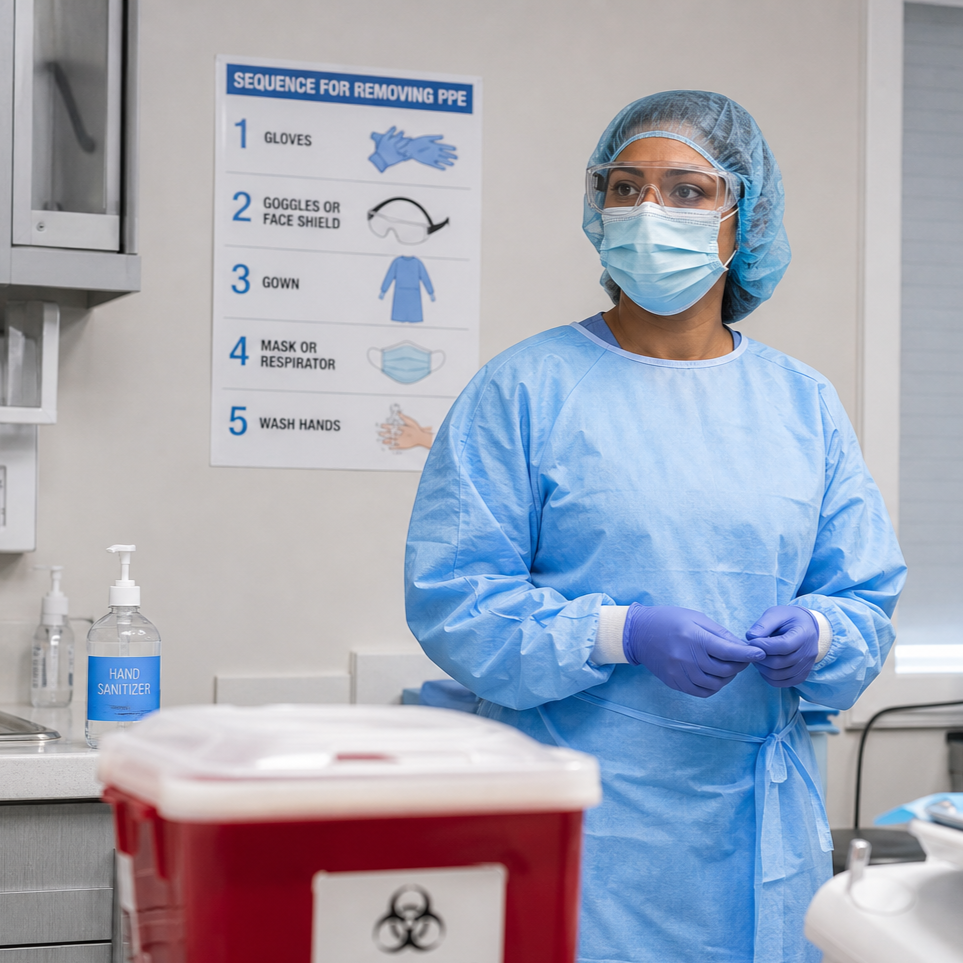
Proper removal sequence as recommended by the CDC: Gloves → Eye protection → Gown or Protective Clothing → Mask or Respirator
The specific PPE required, and the appropriate removal procedure may vary depending on the task and the type of precautions being used.
Removed in the wrong order, PPE can transfer contamination from a heavily-soiled surface to a cleaner one — here's the sequence, and why it goes in this order.
Gloves:
Grasp outside of glove with opposite hand; peel off. Hold removed glove in gloved hand. Slide fingers of ungloved hand under remaining glove at wrist. Peel glove off over first glove. Discard gloves in waste container.
Why this step is first: The outside of the gloves is likely to be contaminated. Removing gloves first reduces the opportunity to transfer contamination to your hands or to the other PPE you still need to remove.
Tip: It is important to keep watches and jewelry off to make this process easy with removal.
Safety Eyewear or Face Shield:
Handle by headband or ear pieces. Place in designated receptacle for reprocessing or in waste container.
Why: Splatter and spray collect on the front surface — treat it as contaminated and handle only the band or ear pieces.
Tip: Clean and disinfect eye protection according to manufacturer's directions if they are not disposable.
Gowns and Protective clothing:
Reusable garments: Remove carefully before leaving the work area, and then perform proper hand hygiene. Disposable garments: Unfasten ties. Pull away from neck and shoulders, touching inside of gown only. Turn gown inside out. Fold or roll into a bundle and discard.
Why: The outside of the gown or protective clothing may be contaminated. Removing it by turning the contaminated surface inward helps reduce the opportunity for contamination of your skin and clothing.
Mask or respirator:
Remove the mask or respirator by handling the ties, elastics, or other designated straps. Do not touch the front of the mask or respirator. Discard disposable equipment appropriately or follow the manufacturer's and facility's procedures for reusable or designated-reuse equipment.
Why last: it's still protecting you from inhalation risk while you remove everything else, so it comes off only once the rest is safely out of the way.
Hand hygiene: Perform hand hygiene immediately after removing PPE.
Wash your hands with soap and water or use an alcohol-based hand rub when appropriate. Hand hygiene should also be performed immediately if your gloves tear or your hands become contaminated during PPE removal.
Removal of personal protective equipment can be one of the riskiest areas in infection control if it is not done properly. Over spray from patient care, debris from processes, saliva, and bloodborne pathogens can cross-contaminate during the process of removal. You may be taking home those pathogens if you are not following the protocols. Reach out to SafeLink Consulting for support.
Discover more about the Importance of Properly Fitting PPE - Personal Protective Equipment.
And once your PPE is on and off correctly, don't overlook the step in between — see our guide to proper hand hygiene in dentistry.
Frequently Asked Questions
What order should PPE be removed? Gloves, then eye protection, then gown or protective clothing, then mask or respirator — always followed by hand hygiene.
Why does PPE removal order matter? Because each layer can carry contamination from patient care; removing them in the wrong order risks transferring that contamination to your skin, clothing, or the next surface you touch.
Learn about the Importance of Properly Fitting PPE (Personal Protective Equipment).
Is your team's infection control training up to date? SafeLink's OSHA and CDC-aligned training helps your staff put PPE removal into practice — not just check a box. → Explore Infection Control Training.
Discover more about Dental OSHA Compliance.
Infection prevention training for your team
Keep your team current with CDC-aligned infection prevention and control training — built around how your practice actually operates.
Explore infection control training ↗ Mary A. Bartlett, CDIPC, Senior Vice President & Founder of SafeLink Consulting, has spent more than three decades at the forefront of dental industry compliance and safety. Since 1991, she has been a trusted presenter and on-site instructor for dental and general industry professionals across the United States, Canada, and Asia — delivering expertise on employee health and safety, patient safety, privacy, and quality assurance. She has authored content for numerous national publications, and her clients consistently benefit from her hands-on experience navigating OSHA, FDA, and State Board inspections. Mary is Certified in Dental Infection Prevention and Control.