Fire Prevention: Risks in Dental Labs & Dental Practices

October Is National Fire Prevention Month
October is National Fire Prevention Month, the perfect time to rethink the fire safety protocols in your dental practice or dental laboratory.
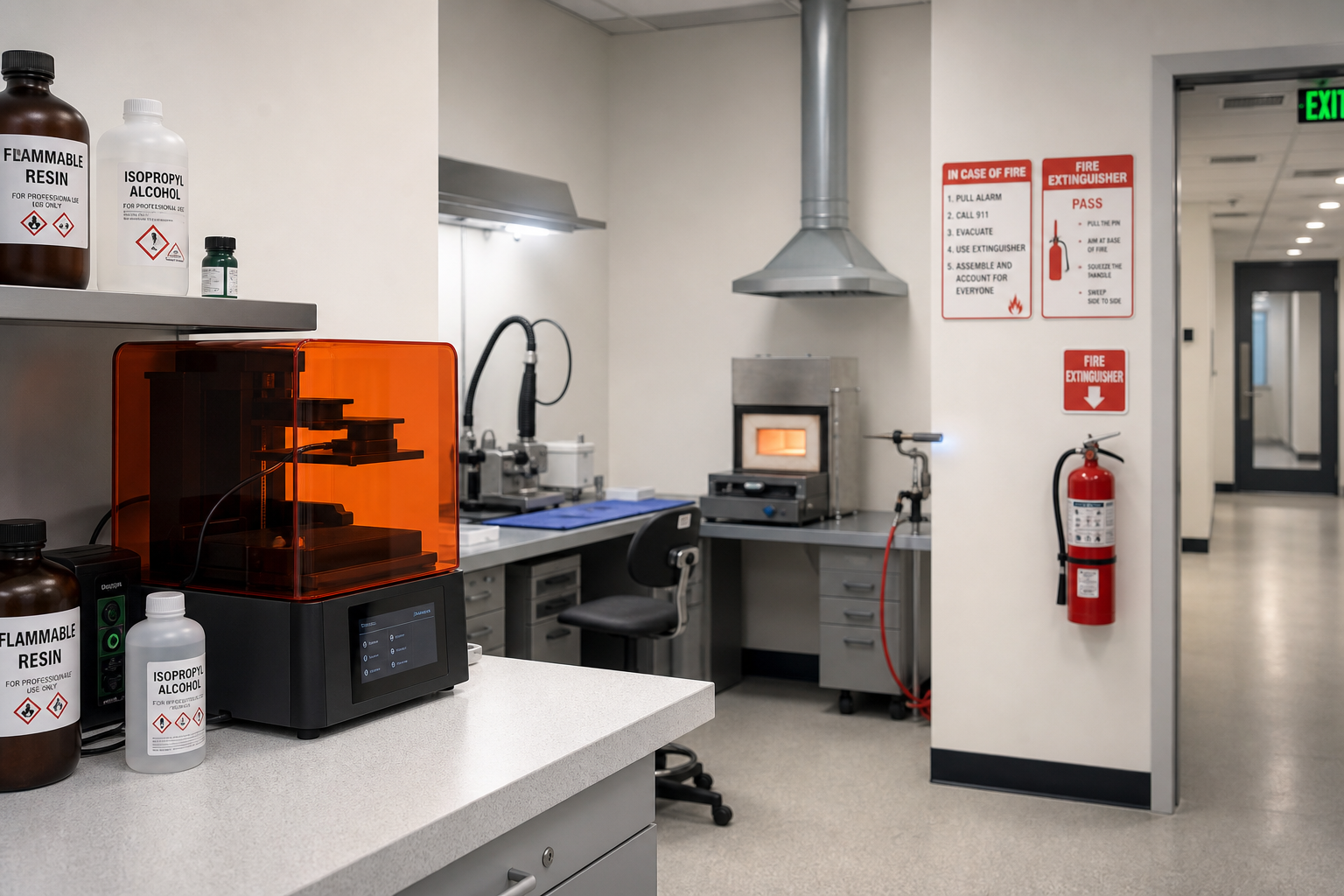
The shift in dentistry from traditional impressions to digital workflows has reduced some biological hazards, but it has introduced new physical ones. The use of 3D printing brings flammable resins and high-concentration isopropyl alcohol into dental offices and dental labs. Add oxygen and nitrous oxide cylinders, dental lasers, and the heat from lab torches and furnaces, and a dental setting carries more fire risk than many people realize.
Dental Fire Hazards at a Glance
Every fire needs fuel, heat, and oxygen. Dental practices and labs often have all three within a few feet of each other: flammable 3D printing chemicals and disinfectants, oxygen and nitrous oxide cylinders, and ignition sources ranging from lasers to lab torches.
Which of these hazards exist in your facility, and how serious each one is, depends on your equipment, layout and workflow. That's what a professional fire risk assessment uncovers.
Where Dental Practices and Dental Labs Fall Short
OSHA expects flammable chemicals to be stored according to its Flammable Liquids standard (1910.106), labeled with Safety Data Sheets on hand under the Hazard Communication Standard (1910.1200), and disposed of under local and state environmental rules. These are the gaps we find most often:
- Flammable chemicals stored or labeled incorrectly
- Missing Safety Data Sheets for newer 3D printing materials
- Oxygen and nitrous oxide cylinders that aren't properly secured
- Ignition sources operating too close to flammable materials
Any one of these can turn a small spark into a serious fire, and each can lead to an OSHA citation. Most are easy to miss from the inside, because they become part of the daily routine.
Your Emergency Action & Fire Prevention Plan
OSHA requires two plans that work together. An Emergency Action Plan (1910.38) covers what everyone does when a fire happens. A Fire Prevention Plan (1910.39) identifies your major fire hazards, your ignition sources and who is responsible for controlling them. Employers with more than 10 employees must have both in writing.
Generic templates rarely account for 3D printing chemicals, oxygen cylinders or lab equipment. They also tend to overlook a challenge unique to healthcare: how you will get patients out safely, including anyone who is sedated or has limited mobility.
Make Fire Safety Everyone's Job
Use this month to review your fire safety procedures with your whole team. Make sure every employee knows where the fire extinguishers are, where the exits are, and what to do when the alarm sounds.
If your employees are expected to use fire extinguishers, OSHA has specific training, inspection and maintenance requirements. Read Fire Prevention in the Workplace: How to Use Fire Extinguishers for OSHA's requirements and the PASS method.
As 3D printing and other digital tools become standard in dental practices and dental labs, fire risks grow with them. If any of the gaps above sound familiar, this October is the time to address them. Learn how to create an Emergency Action Plan for your business.
Not sure where your fire risks are? A SafeLink risk assessment identifies the hazards specific to your practice or lab and shows you where you stand with OSHA before an inspector does.
Does your practice or lab have an Emergency Action & Fire Prevention Plan that meets OSHA's requirements? SafeLink Consulting has helped dental practices and dental labs nationwide with OSHA compliance for over 30 years. Call 770-205-6745 or email info@safelinkconsulting.com for help writing your Emergency Action & Fire Prevention Plan and training your team.
Is your Emergency Action Plan ready?
Get a free Emergency Action Plan Checklist to see where your plan has gaps, or let our team build a compliant EAP for your facility — including a custom emergency evacuation map.
Get the free EAP Checklist ↗ Mary A. Bartlett, CDIPC, Senior Vice President & Founder of SafeLink Consulting, has spent more than three decades at the forefront of dental industry compliance and safety. Since 1991, she has been a trusted presenter and on-site instructor for dental and general industry professionals across the United States, Canada, and Asia — delivering expertise on employee health and safety, patient safety, privacy, and quality assurance. She has authored content for numerous national publications, and her clients consistently benefit from her hands-on experience navigating OSHA, FDA, and State Board inspections. Mary is Certified in Dental Infection Prevention and Control.